Rev. Fac. Agron. (LUZ). 1998, 15: 343-349
Composition of venezuelan lemon essential oil Citrus limon (L.)
Burm.f.
Composición del aceite esencial de limón venezolano Citrus limon (L.) Burm.f.
Recibido el 22-09-1997lAceptado el
22-05-1998
1. Laboratorio de Alimentos, Departamento de Química, Facultad de Ciencias, Universidad
del Zulia, Apartado Postal 526, Maracaibo, Venezuela. Tel.: 061-598062 Fax: 061-495784.
2. Centro de Química de Productos Naturales, Universidad Nacional Experimental del
Táchira, San Cristóbal, Venezuela.
3. Author to whom correspondence should be addressed.
Abstract
Key words: Citrus limon, essential oil, HRGC, GC-MS.
Resumen
Palabras claves: Citrus limon, aceite esencial, HRGC, GC-MS.
Introduction
Essential oils are vegetable products whose constituents are basically a complex mixture of terpenic hydrocarbons and oxygenated derivatives such as like aldehydes, alcohols and esters (8). These are accumulated mainly in secretory cavities scattered throughout the parenchymatous tissues and sometimes in scattered resincells of leaves, petals, pericarps (fruit peels), and petioles (leaf stalks) of many species. Particularly rich in these oils are the families Lameaceae, Lauraceae, Myrtaceae and Rutaceae. The most familiar members of this last taxonomic group are the so called citrus fruits: lemon, lime, orange, mandarin, grapefruit and bergamot; among other species belonging to Citrus genus. Such citrus fruits offer a wide explotation due to the commercial value of the juice from their fruits which has a desirable flavor and contains a high percentage of vitamin C (3). It is also important, the essential oil extracted from their leaves (petitgrain oil) (13) and specially that one obtained from the fruit peels.
The oil extracted from the fruit peels is used as aromatic flavor in sweet and alcoholic beverages, bakeries and confectionery. In pharmaceutical products, the oil is used to mask disagreeable taste of many medicaments; and in perfumery, is a constituent of several international famous fragrances (10).
Aldehydes are the class of substances which mainly contribute to the total content of oxygenated compounds, in particular, neral and geranial (in the past called "citral") and their content has become an important parameter to establish the price of the oil and to represent a reference of quality (6).
The differences in composition of diverse citrus essential oils are rather of quantitative order than qualitative order. However, some of them have certain distinctive compounds. In fact, the multiple components of the oils from each specie depend on its own genetic program, though the composition can be influenced by several environmental and physiological factors such as : tissues age (maturity), climatic season, soil type, storage conditions and extraction method (9).
In Venezuela the cultivation of C. limon lacks of commercial importance (1) but in sub-tropical countries this specie is grown intensively and it is the raw material for one of the most appreciated essential oil in the world.
The composition of volatile fraction of lemon essential oil has been studied in detail by European and American investigators (2, 5, 10, 12, 13, 14, 16). Information about essential oils extracted in tropical countries has not been found. In this paper is reported the characterization and quantification of Venezuelan lemon essential oil using an internal standard and response factors by two analytical methods: HRGC and GCMS.
Materials and methods
Plant Material. The fruits employed in this work were collected from lemon trees grown at a commercial orchard in Baralt Municipality, Zulia State, Venezuela.
The essential oil was extracted from fruit peels by coldpressing, a simple technique recommended for this material (9, 11).
HRGC analyses. The HRGC analyses were performed on a Varian Vista 64 System, mod. 6000; equipped with a flameionization detector (FID), a 60m x 0,32 mm i.d. capillary fused silica crosslinked 5% phenylmethyl silicone column (DB5, J&W) and a capillary system fitted with a split line that allows the gas flow to be splitted 1:40. The carrier gas was helium at a pressure of 26 psi. The oven temperature was 90°C for 3 min, then rose 1°C/min to 126°C continuing with 15°C/min to 200°C and then 20°C/min to a final temperature of 250°C for 5 min. The oil sample analyzed consisted in 20% solution in methylene chloride with 4% nnonane added as internal standard (std.). The injection volume used was 0,8 µl. The oil constituents were identified by comparing their retention times with standards. Detector response factors (RFs) were determined for key components relative to nnonane and assigned to other components on the basis of functional group and/or structural similarity. For RFs determination several solutions consisting of three or four standards, plus nnonane, were prepared in order to prevent interference from trace impurities.
Standards substances of essential oil components were obtained from Sigma Chemical Co., (USA) and Aldrich Co., (USA) and were more than 95% pure.
GC-MS analyses. The GCMS analyses were carried out on a Finnigan Matt Magnum System equipped with a Varian Model 3400 GC and a 60 m version of fused capillary column described above. The initial oven temperature was held at 85°C for 7 min., then programmed at 7°C/min to 220°C, and held there for 30 min. Injection port and ionizing source were kept at 275°C and the transfer line was kept at 280°C. Mass units were monitored from 20 to 350 at 70 eV.
The statistical quantification analyses were completed during an average of six GC runs. A percent relative standard deviation (% RSD) below 5% was obtained for all constituents except for 5 very small components which had a higher % RSD.
Results and discussion
The GC analyses of the essential lemon oil revealed a total of 51 constituents: 28 mono and sesquiterpene hydrocarbons, 8 aldehydes, 10 alcohols, 3 esters, 1 ketone, and 1 oxide.
All compounds listed in table 1 were confirmed by GCMS analyses of the oil. The papers cited appoint differences in composition according to region, extraction process and season. Nevertheless, such differences are not significant and such papers do not present statistical analyses of mean or variance. In fact, the constituents and levels detected in this work are very similar to them .
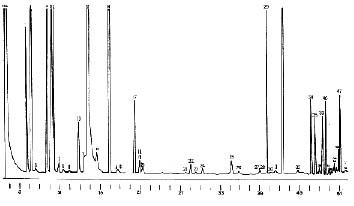
As can be seen, limonene was the major component (65,65%). Among the other monoterpene hydrocarbons, there was a high proportion of bpinene (11,0%) and gterpinene (9,01%). Oxygenated compounds were found in amounts of 3.79%. Aldehydes were the most abundant constituents of this oxygenated fraction (2,70%) specially the quality indicators: geranial (1,43%) and neral (0,87 %) whose levels were very similar to Italian, Californian and Uruguayan lemon essential oils (2, 4, 5). On the other hand, alcohols were represented in 0,53%, esters in 0,56% and just a little percentage of artifacts was found (0,01%). A typical gas chromatogram of Venezuelan lemon essential oil is shown in figure 1.
Table 1. Quantitative data for Venezuelan lemon peel essential oil.
| No.* | Compound | % w/w | % RSD | RF | Cited |
| Monoterpenes: | |||||
| 1 | a-thujene | 0.42 | 3.43 | - | 3, 5, 6, 7 |
| 2 | a-pinene | 1.88 | 0.53 | 1.3 | 3, 5, 6, 7 |
| 3 | Camphene | 0.06 | 0.49 | 1.8 | 3, 5, 6, 7 |
| 4 | Sabinene | 1.05 | 1.82 | 0.9 | 3, 5, 6, 7 |
| 5 | b-pinene | 11.00 | 0.70 | 1.2 | 3, 5, 6, 7 |
| 6 | myrcene | 1.01 | 1.05 | 1.2 | 3, 5, 6, 7 |
| 8 | a-phellandrene | 0.05 | 1.20 | - | 3, 5, 6, 7 |
| 9 | d-3-carene | 0.01 | 0.50 | 1.4 | 3, 5, 6, 7 |
| 10 | a-terpinene | 0.22 | 0.57 | 1.4 | 3, 5, 6, 7 |
| 11 | p-cymene | 0.10 | 1.39 | 3.2 | 3, 5, 7 |
| 12 | Limonene | 65.65 | 0.57 | 1.6 | 3, 5, 6, 7 |
| 13 | Trans-b-ocymene | 0.09 | 0.75 | - | 3, 6, 7 |
| 14 | g-terpinene | 9.01 | 0.95 | 1.06 | 3, 5, 6, 7 |
| 17 | Terpinolene | 0.39 | 15.8 | - | 3, 5, 6, 7 |
| Sub-total: | 90.94 | ||||
| Aldehydes: | |||||
| 7 | Octanal | 0.07 | 1.26 | 0.95 | 3, 5, 7 |
| 20 | Nonanal | 0.12 | 2.32 | 1.6 | 3, 5, 6, 7 |
| 22 | Citronellal | 0.14 | 0.75 | 1.72 | 3, 5, 6, 7 |
| 26 | Decanal | 0.04 | 2.75 | 1.9 | 3, 5, 6, 7 |
| 29 | Neral | 0.87 | 1.04 | 1.25 | 3, 5, 6, 7 |
| 32 | Geranial | 1.44 | 4.43 | 1.25 | 3, 5, 6, 7 |
| 33 | Undecanal | 0.02 | 15.5 | 1.32 | 3, 6, 7 |
| 36,37 | Dodecanal/decyl acetate | 0.01 | 2.20 | 1.3/1.1 | 3, 6 |
| Sub-total: | 2.71 | ||||
| Alcohols: | |||||
| 15,16 | Trans-sabinene | ||||
| hydrate/octanol | 0.05 | 3.94 | - /1.9 | 3, 6, 7 | |
| 18,19 | Linalool/cys-sabinene | ||||
| hydrate | 0.16 | 3.93 | 1.27/ - | 3, 5, 6, 7 | |
| 23 | Borneol | 0.01 | 1.94 | 1.3 | 3, 7 |
| 24 | Terpinen-4-ol | 0.06 | 0.99 | 1.5 | 3, 5, 6, 7 |
| 25 | a-terpineol | 0.17 | 2.73 | 1.77 | 3, 5, 6, 7 |
| 27,28 | Citronellol/nerol | 0.04 | 7.81 | 1.35/1.1 | 3, 5, 6, 7 |
| 31 | Geraniol | 0.03 | 6.55 | 1.05 | 3, 5, 6, 7 |
| Sub-total: | 0.52 | ||||
| Ketone and Oxide: | |||||
| 21 | Camphor | 0.01 | - | 1.97 | 3, 7 |
| 30 | Piperitone | 0.01 | - | - | 3, 7 |
| Sub-total: | 0.01 | ||||
| Esters: | |||||
| 34 | neryl acetate | 0.35 | 0.41 | 1.4 | 3,5,6,7 |
| 35 | geranyl acetate | 0.22 | 0.35 | 1.4 | 3,5,6,7 |
| Sub-total: | 0.57 | ||||
*Peak numbers refer to figure 1.
Table 1. Quantitative data for Venezuelan lemon peel essential oil. Continuación.
| No.* | Compound | % w/w | % RSD | RF | Cited |
| Sesquiterpenes: | |||||
| 38 | cis-a-bergamotene | 0.05 | 10.1 | - | 3 |
| 39 | b-caryophyllene | 0.25 | 1.28 | 1.13 | 3, 5, 6, 7 |
| 40 | trans-a-bergamotene | 0.41 | 1.12 | - | 3, 5, 6, 7 |
| 41 | trans-b-farnesene | 0.04 | 0.16 | - | 3, 13 |
| 42 | a-humulene | 0.02 | 6.51 | 0.96 | 3, 5, 6, 7 |
| 43,44 | b-santalene /cis- | ||||
| b-farnesene | 0.08 | 3.81 | - | 3, 5, 6, 7 | |
| 45 | valencene | 0.03 | 4.09 | - | 3, 5, 15 |
| 46 | germacrene B | 0.11 | 5.08 | - | 6 |
| 47 | b-bisabolene | 0.40 | 1.69 | - | 3, 5, 6, 7 |
| 48 | g-elemene | 0.03 | 0.94 | - | 6 |
| 49 | 2,3-dimethyl-3-(4-methyl-3-pentenyl)-2-norbornanol | 0.03 | 2.15 | - | 3, 6 |
| 50 | campherenol | 0.03 | 3.11 | - | 3, 6 |
| 51 | a-bisabolol | 0.09 | 4.20 | - | 3, 5, 6 |
| Sub-total: | 1.57 | ||||
| Total: | 96.32 | ||||
*Peak numbers refer to figure 1.
Some investigators have used the RFs assigned on the basis of structural similarities when the standard was not available (2, 17). This approach used with the FID detector has very accurate and reproducible results. However, some variation in RFs can be observed with capillary work depending on the injector, liner and column types. The changes can be detected by periodic checking of RFs for a few key compounds with a standard solution. Only Chamblee et al. (2) reported the use of RFs and internal standard. Shaw (16) has argued convincingly for the adoption of these approaches in essential oil analyses due to it was found that the most accurate GC analyses are obtained by using both: an internal standard and response factors.
Also it was confirmed the efficiency of bonded J&W DB5 thick film fused silica capillary column used in previous works (2) on which a good overall separation of lemon oil was obtained.
Figure 1. Capillary GC separation of Venezuelan lemon essential oil. Experimental conditions: capillary column 60 m x 0.32 mm i.d. coated with DB-5, carrier gas He at 26 psi, column temperature 90 ºC (3 min) to 126 ºC at 1 ºC/min to 200 ºC at 15 ºC/min, to 250 ºC (5 min) at 20 ºC/min, injection mode, split, detector FID.
Literature cited
1. Avilán, L., F. Leal y D. Batista. 1992. Manual de Fruticultura. Tomo 2. Editorial America, Caracas, 2da. edición.
2. Chamblee, T., B. Clark, G. Brewster, T. Radford and G. Iacobucci. 1991. Quantitative analyses of the volatile constituents of lemon peel oil. Effects of silica gel chromatography on the composition of its hydrocarbon and oxygenated Fractions. J. Agric. Food Chem. 39 : 162169.
3. Cronquist, A. 1981. An Integrated System of Classification of Flowering Plants. Columbia University Press, New York.
4. Cotroneo, A., A. Verzera, G. Lamonica, G. Dugo and G. Licandro. 1986. On the genuineness of citrus essential oils produced from Sicilian lemons using "Pelatrice" and "Sfumatrice" extractors during the entire 1983/1984 season. Flavor Fragance J. 1: 6986.
5. Dellacassa, E., C. Rossini, D. Lorenzo and P. Moyna. 1995. Uruguayan essential oils. Part III. Composition of the volatile fraction of lemon essential oil. J. Ess. Oil Res. 7: 25-37.
6. Dugo, G. 1994. The composition of the volatile fraction of the Italian citrus essential oils. Perfum.Flavor. 19 : 2951.
7. Fleisher, A., G. Biza, N. Secord and J. Dono. 1987. Ultratech citrus concentrates a new series of deterpenified citrus oils. Perfum.Flavor. 12 (2) : 5761.
8. Huet, R. 1991. Les huilles essentielles d' agrumes. Fruits 46 (4) : 501513.
9. Huet, R. 1991. Les huilles essentielles d' agrumes. Fruits 46 (5) : 551576.
10. Huet, R. 1991. Les huilles essentielles d' agrumes. Fruits. 46 (6) : 671683.
11. Kesterton, J and R. Braddock. 1976. By-products and specialty products of Florida citrus. Institute of Food and Agricultural Sciences. Bulletin 784 (technical). University of Florida, Gainesville, Florida, USA.
12. Lawrence, B. 1989. Progress in Essential Oils. Perfum. Flavor. 14 (4) : 4156.
13. Lawrence, B. 1993. Progress in Essential Oils. Perfum. Flavor. 18 (5) : 4368.
14. Lawrence, B. 1994. Progress in Essential Oils. Perfum. Flavor. 19 (3) : 5969.
15. Morin, P and M. Caude. 1986. Semipreparative separation of terpenoids from essential oils by HPLC and their subsequent identification by GCMS. J. Chromatogr. 383: 5769.
16. Shaw, P. 1979. Review of quantitative analyses of citrus essential oils. J. Agric. Food Chem. 27 (2) : 246257.
17. Staroscik, J.A and A. Wilson. 1982. Quantitative analyses of coldpressed lemon oil by glass capillary gas chromatography. J. Agric. Food Chem. 30 (3) : 507509.